In short
Kombucha is sweetened tea fermented for one to two weeks by a living culture of yeasts and acetic acid bacteria, called a SCOBY. The yeasts turn the sugar into a little alcohol and carbon dioxide, the bacteria turn that alcohol into organic acids, and the result is a tart, lightly sparkling drink with variable residual sugar, some caffeine, and alcohol that may exceed 0.5 percent in home brews.
It is not a mushroom drink, a vinegar, or a medicine. It is a fermented tea, and most of what makes one kombucha different from another is the tea, the time, and the culture that made it.
Kombucha in one paragraph
Take black or green tea, dissolve sugar in it, and add a culture of bacteria and yeast along with some finished kombucha from a previous batch. Cover the jar with a cloth and leave it at room temperature. Over 7 to 14 days the culture transforms some of the sugar, the tea turns sour and slightly fizzy, and a rubbery disc of cellulose grows on the surface. Pour it off, and you have kombucha. That is the whole thing; everything else is detail.
The culture is the interesting part. It is a stable community of yeasts (Brettanomyces, Saccharomyces, Zygosaccharomyces and others) and acetic acid bacteria (Komagataeibacter, Acetobacter, Gluconobacter), often with some lactic acid bacteria. They depend on each other: the yeasts make alcohol the bacteria need, and the bacteria make the acidic environment that keeps competitors out. What a SCOBY is goes into how that partnership works.
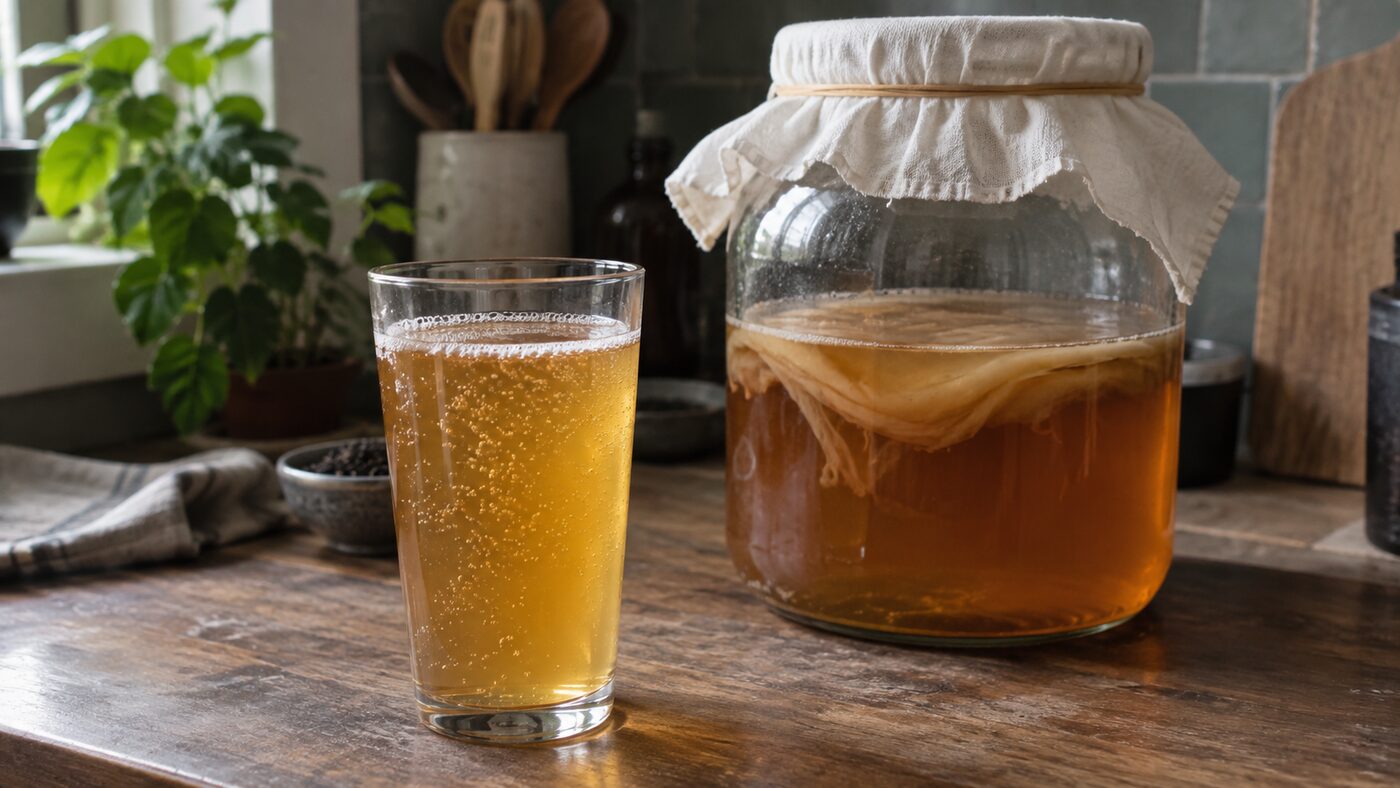
How kombucha is made
The process has two stages. The first fermentation happens in an open jar under a cloth, with oxygen, and it is where the tea becomes kombucha: sugar down, acids up, culture growing. The second fermentation is optional and happens in sealed bottles, usually with a little fruit or juice, and it is where the fizz and most of the flavor come from. Then the bottles go in the fridge, which slows everything down.
At home the ingredients are just water, tea, sugar, and the culture, in a ratio of roughly 5 g of tea and 60 to 70 g of sugar per liter, with 10 to 20 percent starter liquid. Commercial producers do the same at scale, then often filter, flavor, and sometimes pasteurize or dilute the result to keep the alcohol and sugar within legal and label limits. How to make kombucha walks through the home version step by step.
What it tastes like
Young kombucha tastes like sweet tea with a sour edge. A balanced batch is tart, lightly sweet, faintly fizzy, and a little like a dry cider or a sour apple juice, with the tea still recognisable underneath. Left longer it heads toward vinegar. Black tea gives a fuller, rounder drink; green tea a lighter, grassier one. Flavored kombucha layers fruit, ginger, or herbs on top of that base, which is why the bottle in the shop can taste like anything from lemonade to a sour beer.
What is actually in a glass
The numbers below are for finished kombucha. They vary with the tea, the recipe, and above all the fermentation time, so treat them as ranges, not facts about your particular bottle.
| Component | Typical amount | Where it comes from |
|---|---|---|
| Sugar | Varies widely; check the label for a commercial drink. Home brew cannot be estimated reliably from fermentation time alone. | What the culture has not yet eaten. Longer fermentation means less. |
| Organic acids | Mostly acetic and gluconic acid; pH around 2.5–3.5 | Made by the bacteria from the yeasts’ alcohol and from glucose. |
| Caffeine | Varies with the tea and recipe; fermentation does not reliably remove it | From the tea; the amount may change during fermentation. |
| Alcohol | Varies; US non-alcoholic labeling uses a 0.5% threshold, but live drinks may exceed it | The yeasts. Sealed bottles and warmth push it up. |
| Calories | About 15–60 per glass in commercial products | Almost entirely the remaining sugar. |
| Live microbes | Present in raw kombucha, absent in pasteurized | The culture itself: yeasts, acetic and lactic acid bacteria. |
| Tea compounds | Polyphenols and small amounts of B vitamins | The tea, partly transformed during fermentation. |
The sugar, caffeine and calorie rows have their own guide, sugar, caffeine and calories in kombucha, and two more deserve one here. Alcohol, because it is the question people ask most and the one where home brewing differs most from the shop: does kombucha have alcohol? has the numbers. And the live microbes, because “contains live cultures” and “is a probiotic” are not the same claim: is kombucha good for you? looks at what the evidence supports.
Two things are not in the glass, despite what you may read: glucuronic acid in any meaningful amount (most analyses find little or none), and anything that “detoxifies”. Kombucha is a tart drink whose sugar content varies. That is enough.
Raw, pasteurized, hard, and other labels
- Raw or unpasteurized: bottled with the culture still alive. It has to be refrigerated, it keeps fermenting slowly, and it can grow a small pellicle in the bottle. This is the kind you can grow a SCOBY from.
- Pasteurized: heated to stop the culture. Shelf-stable, consistent, no live microbes, and no risk of the alcohol creeping up in the bottle.
- Hard kombucha: deliberately fermented or blended to 4–8% alcohol. An alcoholic drink that happens to start from kombucha.
- Jun: the same idea made with green tea and honey, using its own culture. Lighter, faster, and usually a bit more alcoholic.
- Kombucha concentrate, powders, and “kombucha flavored” drinks: usually not fermented tea at all. Read the ingredients.
How it compares to similar drinks
| Drink | Base | Culture | Character |
|---|---|---|---|
| Kombucha | Sweetened tea | Yeasts and acetic acid bacteria (SCOBY) | Tart, lightly fizzy, tea-based, some caffeine |
| Milk kefir | Milk | Kefir grains (lactic bacteria and yeasts) | Sour, creamy, drinkable yogurt |
| Water kefir | Sugar water, often with fruit | Water kefir grains | Sweet-sour, very fizzy, no caffeine |
| Jun | Green tea and honey | Jun culture | Lighter and more delicate than kombucha |
| Prebiotic soda | Water, fibre, sweetener, flavor | None (not fermented) | Soft drink with added fibre |
| Cider vinegar drinks | Diluted vinegar | None in the bottle | Sharp, flat, no live culture |
The closest relative is water kefir, another home ferment with grains you keep from batch to batch; many kombucha brewers run both. Milk kefir shares the “live culture” idea but is a dairy food. Prebiotic sodas are marketed next to kombucha but are not fermented at all.
Where kombucha comes from
The popular story places kombucha in Manchuria around 220 BC, as a tonic for a Qin emperor. There is no documentary evidence for that, and the name itself may come from a Japanese seaweed tea (konbu-cha) that has nothing to do with fermentation. What is documented is more modest and more recent: fermented tea cultures were being studied in Russia by the early 1900s, with the first known scientific description in 1913, and the drink spread through Germany and central Europe between the wars, sold in pharmacies as a health tonic under names like Kombuchaschwamm and Teepilz.
It stayed a home ferment passed between neighbours for most of the twentieth century, had a wave of popularity in the 1990s, and became a commercial category in the 2000s when bottled brands appeared in natural food shops and then supermarkets. The home brewing tradition never went away, which is why the culture in your jar is probably a descendant of one that has been shared, by hand, for generations.
Is it safe?
For most healthy adults, in normal amounts, yes. The acidity that makes kombucha taste the way it does is also what keeps it safe: a properly fermented batch reaches a pH that helps inhibit harmful bacteria, while clean handling still matters. The documented problems are rare and specific: mold on a home batch, brewing in lead-glazed ceramic, drinking large quantities of an extremely over-fermented brew, and contamination from poor hygiene. Home brewers avoid all of them with a few habits, which how to make kombucha and kombucha mold cover.
Frequently asked questions
Is kombucha alcoholic?
Yes, a little or sometimes more. In the US, non-alcoholic labeling uses a 0.5 percent threshold, but live kombucha can continue fermenting after bottling. Home-brewed alcohol varies too much to infer a number from taste or time. Hard kombucha is deliberately alcoholic.
Is kombucha tea?
Usually it is made with tea leaves, but cultures can also ferment some other sweetened infusions, including rooibos. Those brews may behave differently. Finished kombucha is tart and lightly fizzy.
Does kombucha have caffeine?
Yes. The amount depends on the tea and the brew. Fermentation does not reliably remove caffeine, and green tea is not always lower in caffeine than black tea.
Is kombucha vegan and gluten-free?
Plain kombucha is both: tea, sugar, water, and a culture. Check flavored products for added honey, dairy, or malt-based ingredients.
Why is there a blob in my bottle?
That is a small new pellicle, the same cellulose disc that forms in a brewing jar. It appears in any raw kombucha that has been sitting a while. It is harmless; strain it out or drink around it.
Can I make kombucha without a SCOBY?
You need the culture, but not necessarily the disc. A bottle of raw, unflavored kombucha contains enough of the community to start a batch and grow a new pellicle in two to four weeks. What a SCOBY is explains how.
Does kombucha need to be refrigerated?
Raw kombucha should be refrigerated: cold slows further fermentation and pressure buildup, but does not stop them or guarantee that alcohol stays unchanged. Follow the label for pasteurized products.
Sources
The guidance above draws on these references. Health and safety points are conservative on purpose: home brewing has real variability, and no article can check your batch for you.
These guides were drafted with AI assistance and reviewed by a hobby home kombucha brewer.
- Jayabalan, R. et al. (2014). A review on kombucha tea: microbiology, composition, fermentation, beneficial effects, toxicity, and tea fungus. Comprehensive Reviews in Food Science and Food Safety
- Microbial and chemical profiles of commercial kombucha products (2022). Fermentation
- Fermented tea as a food with functional value: microbiological profile, antioxidant potential and phytochemical composition (2024). Molecules
- Alcohol and Tobacco Tax and Trade Bureau (TTB): Kombucha information and resources
- Colorado State University Extension: Understanding and Making Kombucha