In short
Yes. In the United States, 0.5 percent alcohol by volume is the labeling threshold for a non-alcoholic kombucha, but live bottles can keep fermenting and may exceed it. Home-brewed kombucha varies widely; a warm, sugary second fermentation in sealed bottles can raise the alcohol further. If you need to avoid alcohol, do not assume a home batch is below any particular percentage.
The alcohol comes from the yeasts; the bacteria then turn most of it into acid, but only while there is oxygen. To keep it low: a long open first fermentation in a wide jar, modest sugar at bottling, a short second fermentation, and the fridge.
Where the alcohol comes from
Kombucha is made by two groups of microbes working in sequence. The yeasts split the sugar in the tea and turn it into ethanol and carbon dioxide, exactly as they do in beer or wine. The acetic acid bacteria then take that ethanol and oxidise it into acetic acid, the sourness of kombucha. An open jar gives the bacteria oxygen, but alcohol levels still vary by culture and batch; taste cannot confirm a low percentage. What is kombucha covers everything else that ends up in the glass.
The balance shifts when the bottle is sealed. The bacteria need oxygen and slow right down; the yeasts do not, and they keep converting whatever sugar is left, plus anything you added for flavor, into alcohol and fizz. That is why the second fermentation is where most of the alcohol in a home brew is made, and why the same recipe can give very different numbers depending on how long the bottles sat and how warm the kitchen was.
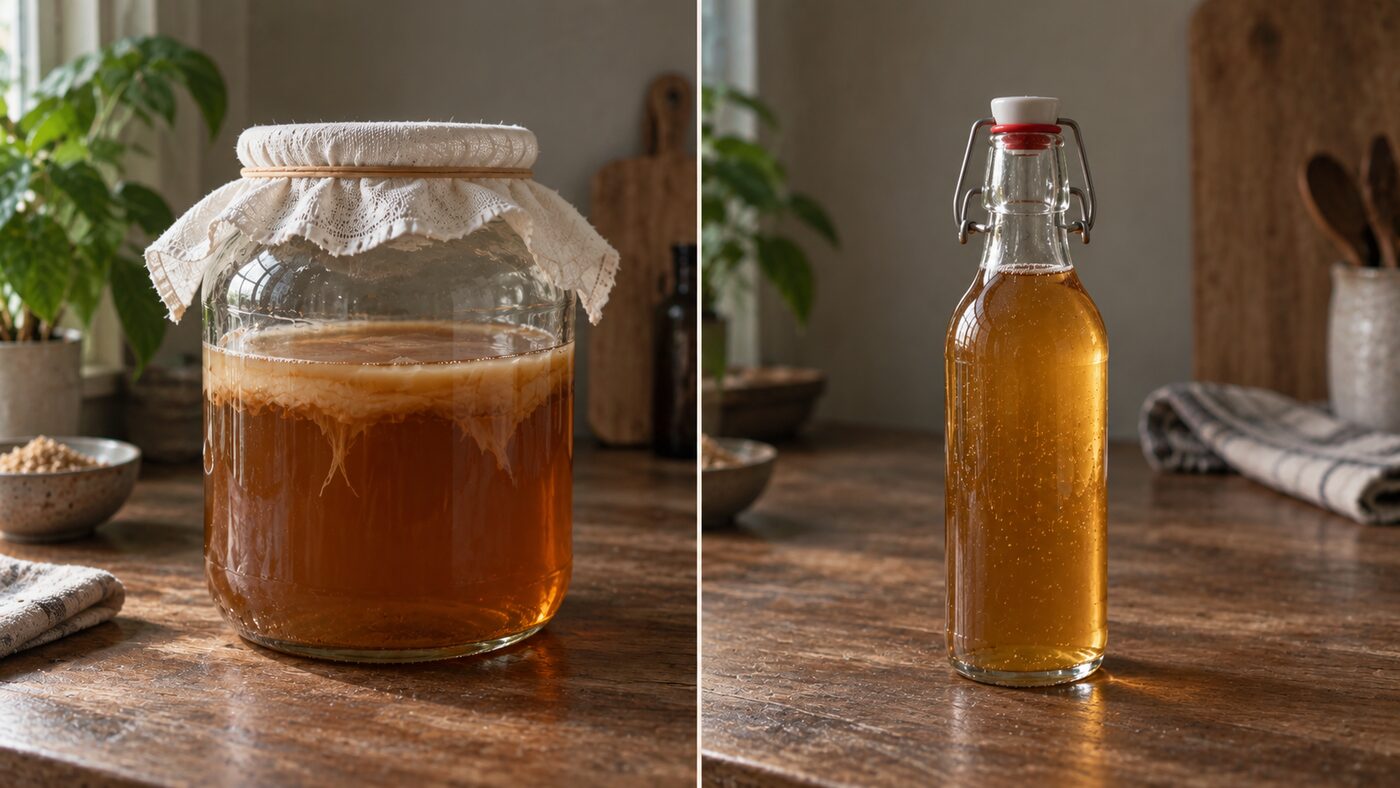
Open jar, with oxygen: sugar → ethanol → acetic acid. Bacteria turn the alcohol into acid.
Sealed bottle, little oxygen: sugar → ethanol, then stalls. Alcohol builds up instead.
How much alcohol is in kombucha
| Kombucha | Typical alcohol by volume | Notes |
|---|---|---|
| Commercial, sold as non-alcoholic | US labeling threshold: under 0.5% | The US legal line. Producers test, dilute, filter or pasteurize to stay under it. |
| Commercial, as actually measured | Often 0.5–1%, occasionally more | A Canadian survey of 84 products found an average of 0.77% and a maximum of 3.6%. |
| Home brew, after the first fermentation | About 0.3–1% | Open jar, oxygen, bacteria keeping up with the yeasts. |
| Home brew, after a second fermentation | 0.5–2%, sometimes up to 3% | Sealed bottles, added sugar, warmth and time all push it up. |
| Hard kombucha | 4–8% | Made to be alcoholic, with extra sugar or yeast, or blended with spirits. |
| For comparison: light beer | 3–4% | A 330 ml beer has roughly the alcohol of 1–2 liters of a typical home kombucha. |
The Canadian survey is worth dwelling on, because it tested products that were labelled non-alcoholic: nearly a third were over the 1 percent local limit, and products from small producers and farmers’ markets ran higher than mass-market brands. Big brands have laboratories and cold chains; a home kitchen has neither. So if commercial kombucha can drift, a home brew certainly can. Regulators make the same point: US guidance notes that fermentation can continue in the bottle and that refrigeration alone is not a reliable way to hold the level down.
What pushes the alcohol up, and down
- Sugar at bottling. Every gram of sugar the yeasts eat in a sealed bottle becomes alcohol and gas. Fruit, juice and added sugar all count. Half the sugar, roughly half the extra alcohol.
- Time in sealed bottles. A one-day second fermentation adds a little; a week adds a lot. Once the bottles are in the fridge, it slows but does not stop.
- Temperature. Warm rooms speed the yeasts up more than the bacteria. Summer batches run higher.
- The culture. A yeast-heavy culture, with lots of brown strands and a fast fizz, makes more alcohol. Strong, acidic starter liquid from a hotel evens it out.
- Oxygen during the first fermentation. A wide jar with a cloth cover gives the bacteria the air they need to convert the alcohol. A narrow bottle, a loose lid, or a jar filled to the brim does not.
- How sour you let it get. A batch that went a bit long has already turned most of its alcohol into acid. A batch bottled sweet still has fuel for the yeasts.
How to keep home-brewed kombucha low in alcohol
- Use a wide jar and a breathable cloth cover, and let the first fermentation run until the batch is properly tart, not just off-sweet. How long to ferment kombucha explains how to read that point.
- Bottle with modest sugar: 30–60 ml of juice or half a teaspoon of sugar per 500 ml, not more.
- Keep the second fermentation short, one to three days at room temperature, and test a bottle rather than waiting for a calendar.
- Refrigerate as soon as the fizz is right, and drink within a few weeks rather than months.
- Skip the second fermentation entirely when it matters. Kombucha straight from the jar, chilled, is finished kombucha with the lowest alcohol you will get.
- Keep the culture in balance with strong starter liquid and a hotel, so the bacteria have the upper hand.
Can you measure it at home?
Not reliably. A hydrometer or refractometer, the home brewer’s usual tools, estimate alcohol from the change in sugar density, and kombucha breaks that logic: the sugar is turned into acids as well as alcohol, the acids have their own density, and the starting point is a mix of tea and starter liquid. Readings can be off by a factor of two or more. Test strips sold for kombucha are rough at best. The only accurate answers come from a laboratory using gas chromatography, which commercial producers use and hobbyists rarely need.
You can control the inputs: use a tart first fermentation, add modest sugar at bottling, keep the sealed stage short, and refrigerate promptly. These habits can limit further alcohol production, but they cannot tell you whether a home batch is under 1 percent. Only a suitable alcohol test can do that.
Who should take the alcohol into account
- Children. A glass of home brew can carry more alcohol than a sip of beer. Many families serve young children none, or a small amount of first-fermentation kombucha only.
- Pregnancy and breastfeeding. Health advice is to avoid alcohol entirely, and raw kombucha adds unpasteurized microbes and caffeine to the question. Most guidance says skip it, or ask a doctor.
- Anyone avoiding alcohol for health, recovery, religious, or medication reasons. A trace in a commercial bottle may be acceptable to some and not to others; a home brew is a real, if small, amount.
- Driving. Ordinary amounts of kombucha will not put a healthy adult near a legal limit, but a liter of a strong home brew is roughly a small beer. Use judgement.
- People taking medicines that react with alcohol, such as disulfiram or metronidazole, should treat kombucha as containing alcohol, because it does.
Is kombucha good for you? covers the wider health picture, including caffeine, acidity, and who is advised to avoid raw kombucha altogether.
A note on the legal limits
The thresholds only matter if you sell kombucha, but they explain the numbers on labels. In the United States a beverage is alcoholic at 0.5 percent by volume, and a kombucha that reaches that level at any point in production, including in the bottle, falls under alcohol regulation. Canada allows up to 1.1 percent in a non-alcoholic beverage. The United Kingdom uses 0.5 percent; European countries vary, typically between 0.5 and 1.2 percent. None of this applies to a jar in your kitchen, but it is why commercial kombucha is engineered to stay low and home brew is not.
Frequently asked questions
Can you get drunk on kombucha?
Not on commercial kombucha in any realistic quantity. A strong home brew at 2 to 3 percent is a different matter: a liter of it is comparable to a beer, so drink it like a mildly alcoholic drink rather than like water.
Does kombucha show up on a breathalyzer?
Immediately after drinking it, a breath test can pick up alcohol in the mouth for a few minutes, as with mouthwash. Beyond that, normal amounts of kombucha do not raise blood alcohol meaningfully. Large amounts of a strong home brew can.
Does refrigeration stop the alcohol from rising?
It slows it down a great deal but does not stop it, which is why regulators do not accept refrigeration as a control on its own. A raw bottle left for months in the fridge will be fizzier, more sour, and a little more alcoholic than when it went in.
Is kombucha halal or suitable for people who avoid all alcohol?
Opinions differ. Some authorities accept the trace alcohol produced naturally in fermented foods such as kombucha, vinegar, or bread; others do not. Home brew is harder to argue for than a tested commercial product. If it matters to you, ask the authority you follow.
Is hard kombucha just kombucha left longer?
No. Leaving kombucha longer makes it sour, not strong, because the bacteria keep converting the alcohol. Hard kombucha is made with extra sugar and beer or wine yeasts, in conditions that favour alcohol, and is a deliberate alcoholic drink.
Does the alcohol have any benefit or purpose?
In the ferment, yes: it is the intermediate that becomes the acids, and it helps keep unwanted microbes out along the way. In the glass, no. It is simply a by-product that a careful brewer keeps small.
Sources
The guidance above draws on these references. Health and safety points are conservative on purpose: home brewing has real variability, and no article can check your batch for you.
These guides were drafted with AI assistance and reviewed by a hobby home kombucha brewer.
- Alcohol and Tobacco Tax and Trade Bureau (TTB): Kombucha information and resources
- Ethanol concentration of kombucha teas in British Columbia, Canada (2021). Journal of Food Protection
- BC Centre for Disease Control: Safety of Fermented Foods, section 3.11 Kombucha and Jun (2024)
- Talebi, M. et al. (2017). Examination of the varied and changing ethanol content of commercial kombucha products. Food Analytical Methods
- Colorado State University Extension: Understanding and Making Kombucha