In short
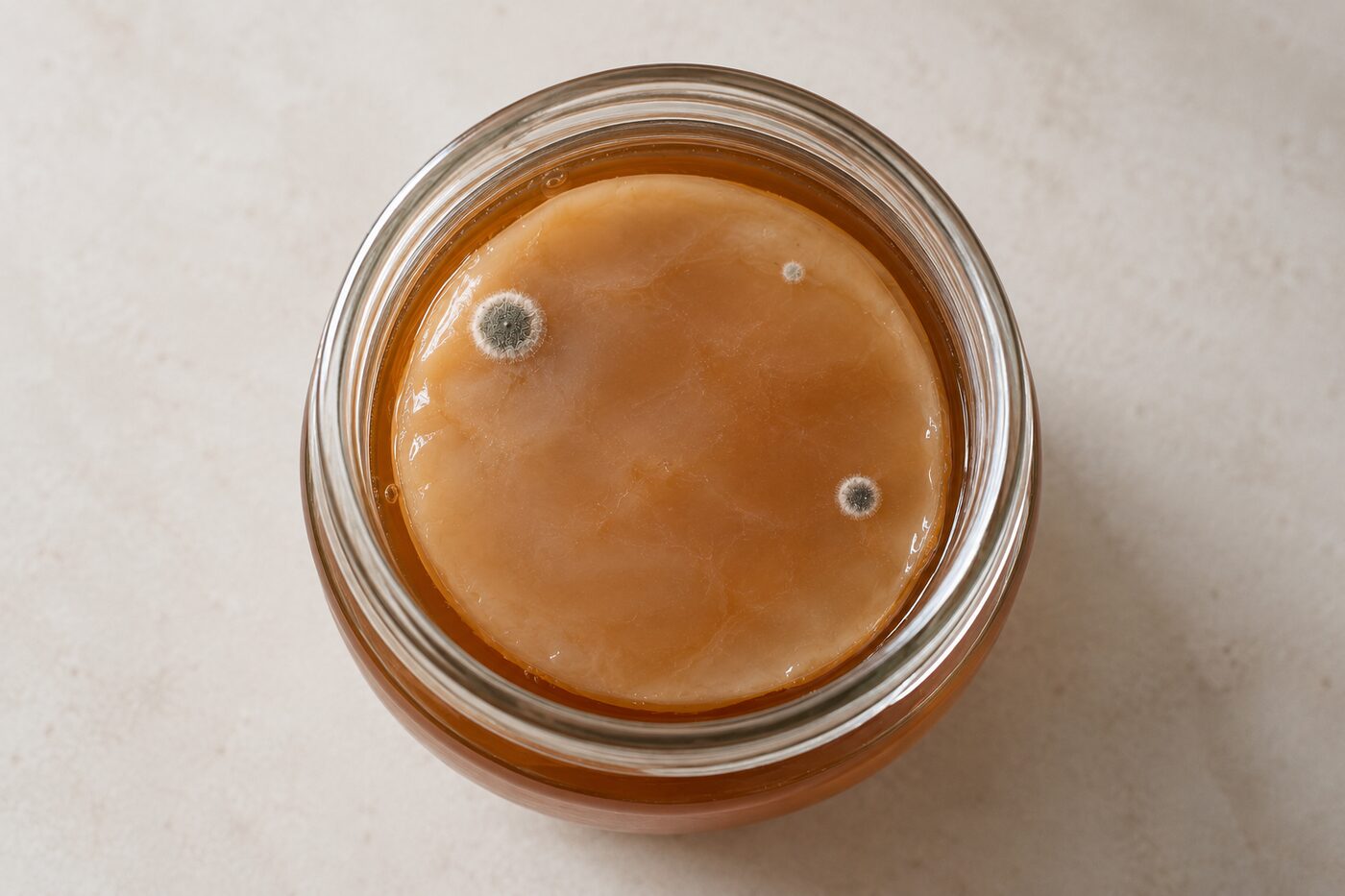
Mold on kombucha is fuzzy, dry-looking and usually round, sitting on top of the SCOBY or the surface film, in white, green, blue, grey or black. If you see that, throw away the whole batch, SCOBY and liquid included, wash everything, and start again with fresh starter.
Brown strings, bumpy or bubbly patches, a translucent skin, dark spots inside the SCOBY, or a flat wrinkled white film are not mold. Look, smell, and if in doubt wait a day: mold grows fuzzier, everything else does not.
What mold on kombucha looks like
- Fuzzy, hairy or powdery. Real mold looks like the mold on bread or old fruit.
- Dry, and sitting on top of the surface, rather than wet and part of it.
- Round spots with a defined edge, sometimes with rings, sometimes spreading into a patch.
- White with a coloured tint, green, blue-green, grey, black, or occasionally pink or orange.
- Only at or above the liquid line: on top of the pellicle, on the surface film, or on a piece of SCOBY stuck to the jar wall.
Mold usually grows on the exposed surface, especially early in fermentation before the tea has acidified. Submerged yeast strands and wet pellicle folds are often normal, but location alone cannot identify every growth. If you see fuzzy growth or are unsure what it is, discard the batch rather than taste it.
What is not mold, even if it looks scary
- Brown, stringy or clumpy strands hanging under the SCOBY or floating in the liquid. That is yeast. It is a sign of an active culture.
- Bumps, bubbles, holes and ridges in the new pellicle. Trapped carbon dioxide pushes the young layer around while it forms.
- A translucent, wet, glossy skin on the surface of the liquid, sometimes patchy. That is the new pellicle starting.
- A thin, flat, white or cream film that looks wrinkled, chalky or like cling film across the entire surface. That is kahm yeast (see below).
- Dark brown or almost black patches inside an old, thick pellicle. Those are yeast and tea deposits, and they sit flat.
- A SCOBY that sinks, floats sideways, or grows in two pieces. Perfectly normal.
- A sharp, vinegary smell. That is what fermenting tea smells like.
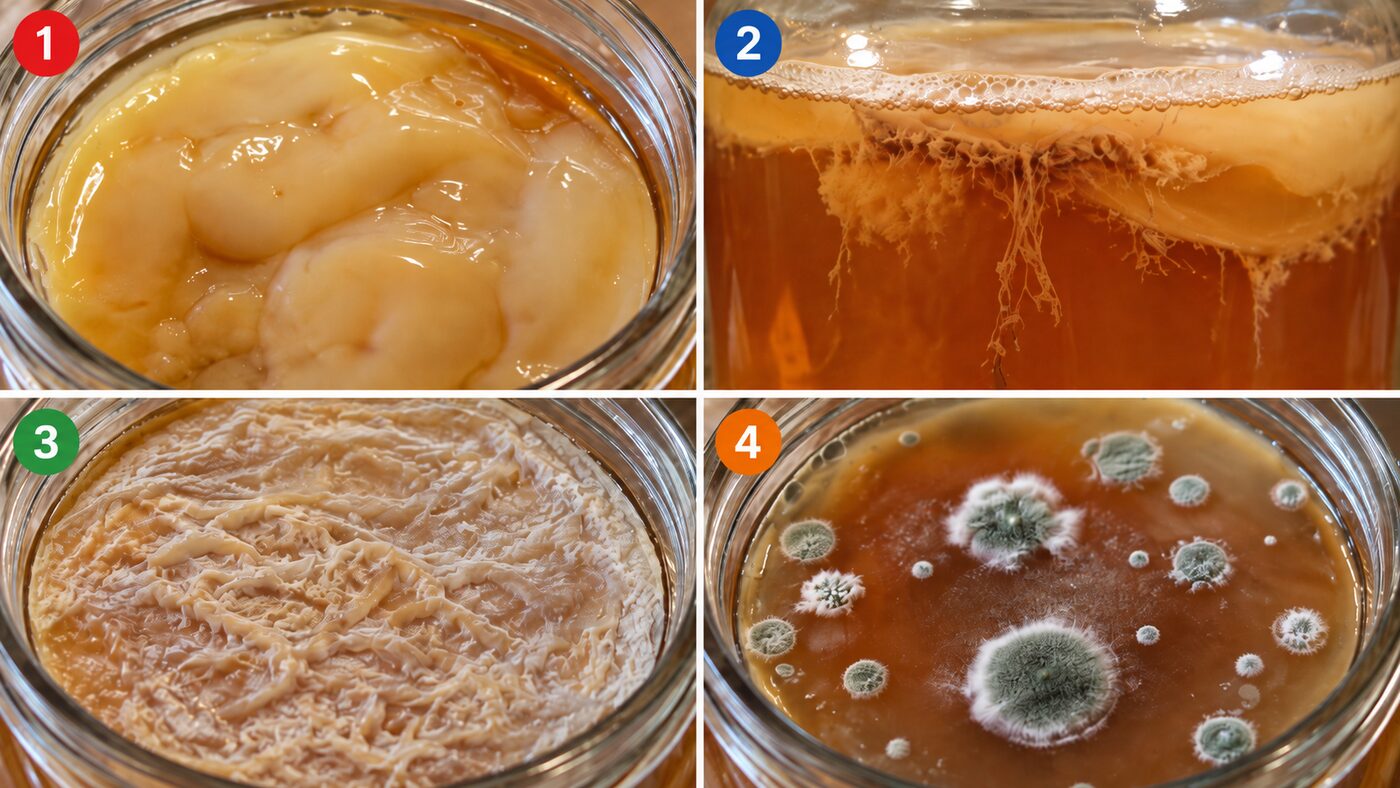
- Healthy pellicleSmooth, wet and glossy. Can be white, cream or light brown.
- Yeast strandsBrown, stringy strands under the surface. Totally normal.
- Kahm yeastFlat, dry, wrinkled film. Usually white or off-white. Not fuzzy.
- MoldDry, fuzzy, round spots. Can be white, green, black or other colors. Discard immediately.
Kahm yeast
Kahm yeast is the one that confuses everyone. It is a flat, white, wrinkled or powdery-looking film that spreads across the whole surface, often with a faintly yeasty or off smell. It is not dangerous, but it shows the culture is out of balance: usually too warm, too little starter, or too much oxygen. Skim it off, make sure the next batch starts with plenty of strong starter, and it normally clears up. If you cannot decide whether a film is kahm or mold, treat it as mold.
The one-minute check
- Do not touch it yet. Look from above in good light, and from the side through the glass.
- Fuzzy, hairy or dry-looking? Mold. Wet, smooth, glossy or stringy? Not mold.
- Round spots with defined edges, or rings? Mold. A film across the entire surface? Pellicle or kahm yeast.
- Green, blue, grey, black or pink? Mold. Cream, tan, brown or translucent? Normal.
- Smell it. Fresh vinegar and tang are normal. Musty, moldy or rotten means mold.
- Still unsure? Put the cover back and check again in 24 hours. Mold grows visibly fuzzier and larger. Yeast and pellicle do not.
What to do if it is mold
- Throw away the liquid, the SCOBY, and any other layers that shared the jar.
- Wash the jar, the cloth and every tool in hot, soapy water, and rinse well. A rinse with white vinegar or a few minutes in boiling water is extra insurance for the jar.
- Restart from a SCOBY hotel or a new culture, with plenty of strong, sour starter liquid.
- Work out what changed. Mold is a symptom, and the causes below are all fixable.
It hurts to bin a culture, but it is cheap to replace and the alternative is not worth it. Extension services and health agencies say the same thing: discard the SCOBY and the kombucha. Some molds produce toxins, you cannot tell which by looking, and the low pH of kombucha does not neutralise them.
Why mold happens
- Too little starter liquid, so the pH stayed too high for too long. This is the number one cause.
- A weak, old, refrigerated or stressed culture that acidified the tea slowly.
- A cold room, which slows the acidification the same way.
- Mold spores in the air, from a fruit bowl, houseplants, a compost bin, fresh bread, or an open window onto the garden.
- Part of the SCOBY sticking to the jar wall above the liquid and drying out. Mold likes dry surfaces.
- A dirty cloth cover, or one loose enough for fruit flies.
- Fruit or flavourings added during the first fermentation, and cigarette smoke nearby.
Smells, fruit flies and other worries
Two things get reported as mold that are neither. The first is smell: a sharp vinegar note, or a slightly yeasty, bready one, is normal, especially in a warm room or a yeast-heavy batch. The smell that matters is musty or rotten, and it comes with visible fuzz. The second is fruit flies. They love the vinegar, and if the cover is loose they lay eggs on the pellicle. Tiny larvae on the surface mean the batch goes in the bin, but they are not mold, and a tightly woven cloth prevents both problems.
Treat pink or orange patches as possible contamination. Their color alone cannot tell you whether they are harmless, so discard the batch rather than scraping them off or tasting it.
How to prevent it
- Use 10 to 20 percent strong starter liquid in every batch. Hotel liquid is ideal. This alone prevents most mold.
- Keep the jar at 20 to 26 °C (68 to 79 °F). If your kitchen is cold, warm the jar, not the recipe.
- Clean, not sterile. Hot soapy water and a good rinse for everything that touches the brew.
- A tightly woven cloth and a rubber band. Not loose muslin, not a lid.
- A spot away from produce, plants, compost and open windows.
- Tuck the SCOBY under the surface when you start, so nothing dries out above the liquid.
- Keep a SCOBY hotel, so a moldy batch is a setback, not a restart from zero.
If you are short of starter, some brewers add a tablespoon of distilled white vinegar per liter of sweet tea to lower the pH in the meantime. It works, but more starter is the better fix. How to make kombucha and what a SCOBY is cover the habits that keep a culture strong.
Frequently asked questions
There is white stuff on my kombucha. Is it mold?
It depends on the texture. Fuzzy, dry, round white spots on top are mold. A smooth, wet, translucent film is the new pellicle. A flat, wrinkled white film across the whole surface is kahm yeast, which is harmless. When in doubt, wait 24 hours and look again.
Can I remove the SCOBY and still drink the liquid?
No. The liquid shared the jar with the mold, and spores and any toxins are not confined to the disc. Discard both.
Can mold grow in the bottle during the second fermentation?
Rarely, because the bottle is sealed and the liquid is acidic. It can happen if pieces of fruit sit above the liquid in the headspace during a long, warm second fermentation. If anything in a bottle is fuzzy, discard it.
My SCOBY hotel molded. Is everything lost?
Only that jar. Any culture in a separate jar is unaffected. This is exactly why it is worth keeping spare layers in more than one place.
Is kombucha mold dangerous?
Nobody has studied kombucha mold specifically, but mold on food in general can cause allergic reactions, and some species produce toxins. Food-safety agencies advise throwing away soft, wet foods that have molded rather than cutting the mold away, and kombucha is exactly that kind of food.
There are black spots on my SCOBY. Is that mold?
Flat, dark brown or black patches inside or under an old, thick pellicle are usually yeast and tea deposits. Raised, fuzzy black spots on top are mold. The texture is the tell.
Does a bigger or thicker SCOBY protect against mold?
No. Protection comes from acidity, and acidity comes from starter liquid, not from the disc. A thin new pellicle in plenty of strong starter is far safer than a thick old one in weak, sweet tea.
Sources
The guidance above draws on these references. Health and safety points are conservative on purpose: home brewing has real variability, and no article can check your batch for you.
These guides were drafted with AI assistance and reviewed by a hobby home kombucha brewer.
- Colorado State University Extension: Understanding and Making Kombucha
- USDA Food Safety and Inspection Service: Molds on food, are they dangerous?
- BC Centre for Disease Control: Safety of Fermented Foods, section 3.11 Kombucha and Jun (2024)
- Kombucha Kamp: Kombucha mold information and pictures
- Brew Buch: Kombucha mold vs. not mold, a photo guide