In short
A SCOBY is a symbiotic culture of bacteria and yeast: the acetic acid bacteria and yeasts that turn sweet tea into kombucha. The rubbery disc most people call the SCOBY is really the pellicle, a mat of cellulose those bacteria build on the surface. The living culture is in the liquid too, which is why starter liquid matters as much as the disc.
You can buy one, get one from a brewer, or grow one from a bottle of raw, unflavoured kombucha in two to four weeks. Spare layers keep for months at room temperature in a jar of kombucha, a so-called SCOBY hotel.
What a SCOBY actually is
SCOBY stands for symbiotic culture of bacteria and yeast. It is not a mushroom, even though “tea fungus” and “kombucha mushroom” are old nicknames, and it is not a single organism. It is a community. The yeasts (typically Brettanomyces, Saccharomyces, Zygosaccharomyces and relatives) split the sugar in the tea and turn it into a little alcohol and carbon dioxide. The acetic acid bacteria (Komagataeibacter, Acetobacter and Gluconobacter) take that alcohol and turn it into acetic acid, and make gluconic acid from the glucose. Together they produce the tartness, the light fizz and the acidity that keeps other microbes out.
The disc is a by-product of that partnership. Komagataeibacter bacteria secrete cellulose, the same polymer as plant fibre, and weave it into a floating mat at the surface where they have the most oxygen. Researchers who sequenced the cultures used by commercial brewers in North America found that the mix of species varies a lot from one brewery to the next, and household cultures vary just as much. That is part of why two brewers using the same recipe get different kombucha.
The disc versus the liquid
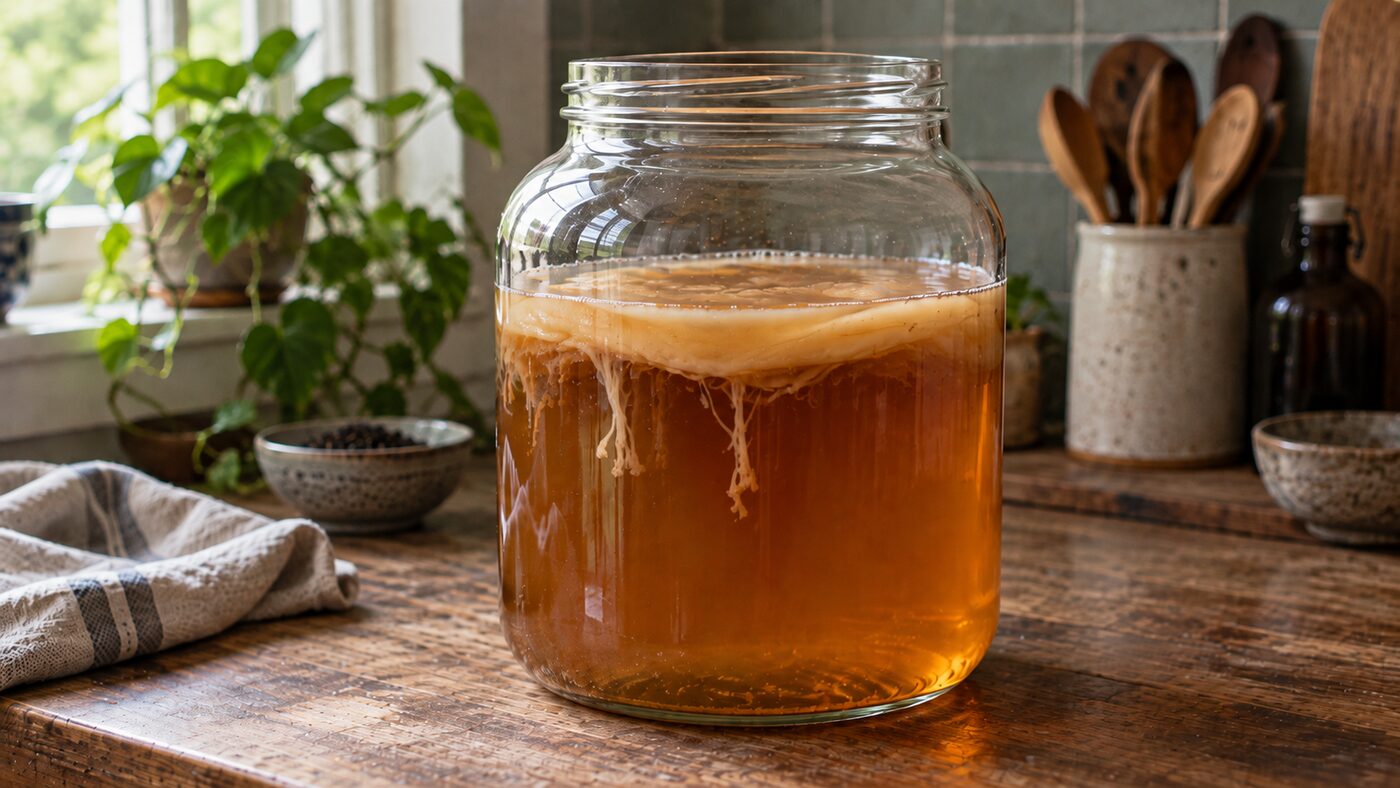
The most useful thing to know about a SCOBY is that you do not strictly need the disc. A batch started with only a generous amount of strong starter liquid will ferment and grow a brand-new pellicle within a week or two. The liquid carries the whole community. The disc is a convenient home for the bacteria, holds some yeast, and helps a new layer form evenly, but a thick pellicle is not a stronger culture. It is just older.
What the liquid also brings is acidity. Fresh sweet tea is a neutral, sugary broth that anything could grow in; a good dose of starter drops its pH within minutes and gives the kombucha microbes a head start. That is the safety mechanism of the whole process, and how to make kombucha covers how much to use.
What a healthy SCOBY looks like
- Colour from off-white to tan. It darkens with age and with black tea, and can pick up colour from the tea.
- Texture smooth and rubbery, or bumpy and jelly-like. Both are normal.
- Brown, stringy or clumpy strands hanging underneath or trapped inside. That is yeast, and it is a sign of an active culture.
- Holes, ridges, bubbles trapped under the surface, thin patches, a layer that floats sideways or sinks to the bottom. All normal.
- A translucent, wet, glossy film on the surface of the liquid. That is the newest layer forming.
What is not normal is dry, fuzzy, raised spots in white, green, blue or black on top of the pellicle. That is mold, and the batch and culture have to go. Kombucha mold shows the difference side by side.
Why a new layer forms every batch
Every batch, the bacteria build a fresh pellicle at the surface. The old disc either attaches underneath it or sinks. After a few batches you have a stack of layers, and the cellulose keeps coming as long as you keep brewing. You can peel the layers apart with clean hands: keep one or two for brewing, put the rest in a hotel, give them to friends, or compost them.
The oldest layers darken and get thick and leathery. They still work, but most brewers retire a layer once it turns dark brown or starts to smell stale, and brew with the newest, palest ones. The culture renews itself; the discs are replaceable.
How to grow a SCOBY from a bottle of kombucha
- Buy a bottle of raw, unpasteurised, unflavoured kombucha. Look for “raw”, “live cultures” or “unpasteurised” on the label; it will be in the chilled section. Flavoured ones rarely work, and pasteurised ones never do.
- Brew a cup of sweet tea: 250 ml of water, one tea bag or a teaspoon of loose black tea, and a tablespoon of sugar. Let it cool completely.
- Pour the tea and the whole bottle of kombucha into a clean glass jar. Cover it with a tightly woven cloth and a rubber band.
- Keep it at 20 to 26 °C (68 to 79 °F), out of direct sun. A translucent film usually appears within a week and thickens over the following two or three.
- When the liquid smells clearly tart and shows no mold, use it as starter for a small first batch; a thick pellicle is not required. Scale up after that batch ferments well.
Do not rush it, and do not top it up with more sweet tea until the pellicle has formed. If fuzzy spots appear at any point, throw it away and start again with a new bottle. It usually takes two to four weeks.
Buying or borrowing a SCOBY
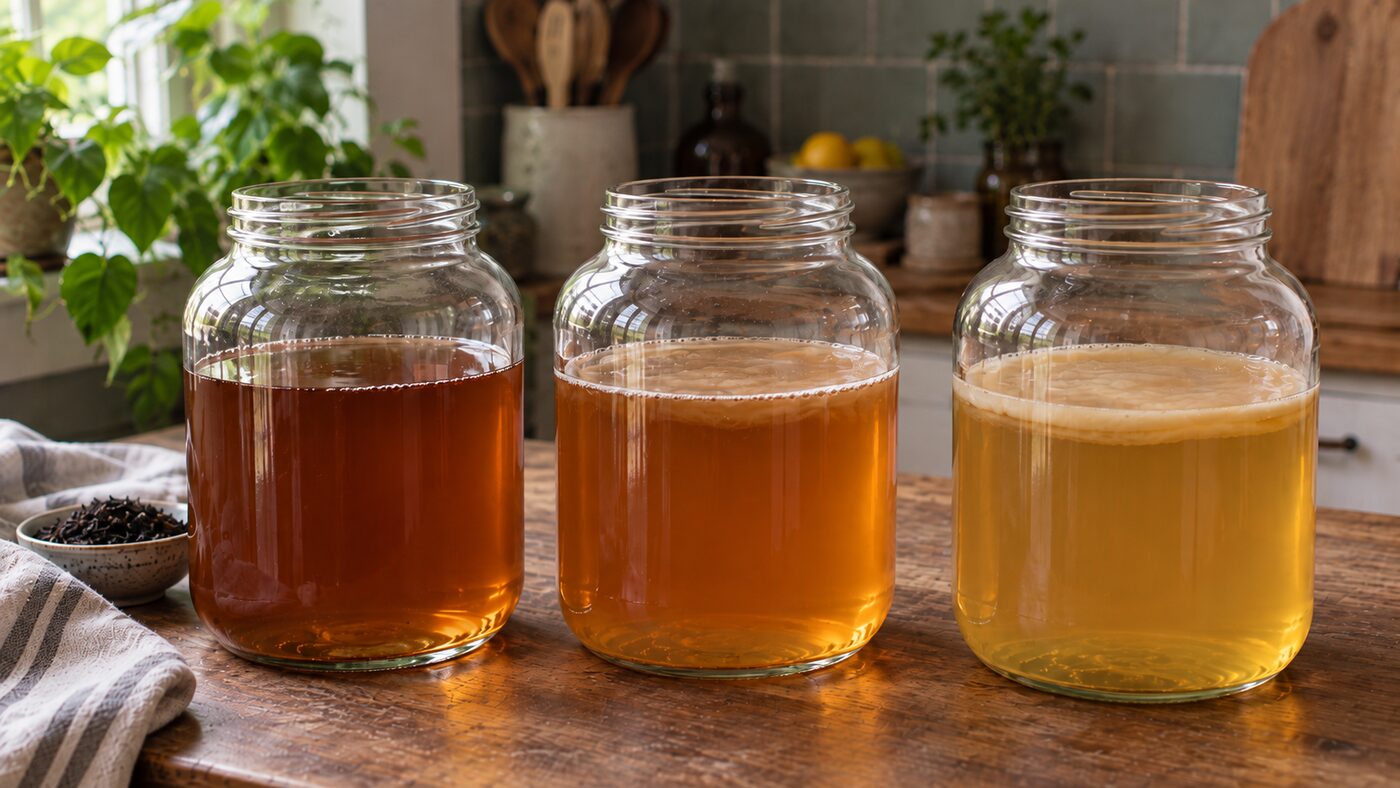
The fastest route is a culture from someone who already brews: a fresh layer in a cup of their starter liquid will ferment your first batch within a week. Shops and online sellers offer cultures too, either fresh in liquid or dehydrated. A fresh one should arrive pale, wet and in clearly sour liquid, and can be used straight away. A dehydrated one needs several batches to recover and fails more often. Whatever the source, what you are really buying is the starter liquid, so make sure you get at least a cup of it, and pass on any culture that arrives dry, in sweet liquid, or with fuzzy spots.
Storing spare SCOBYs: the SCOBY hotel
A SCOBY hotel is just a jar where spare layers rest in kombucha between batches. Fill a clean glass jar with your extra pellicles and enough finished kombucha to cover them, put a cloth cover on it, and keep it at room temperature. It keeps fermenting slowly and gets very acidic, which is exactly what makes hotel liquid the strongest starter you can have.
- Feed it every four to six weeks: pour off some of the liquid and replace it with fresh sweet tea, so the culture has something to eat.
- Remove the thick yeast sediment now and then, and give the jar a rinse when you feed it.
- Keep an active SCOBY hotel at room temperature. Refrigeration slows the culture and it may need time to recover, but a short stay in the fridge does not automatically ruin it.
- Cloth cover, never an airtight lid. The bacteria need oxygen.
- Use the hotel liquid as starter when a batch needs a strong start, and keep the hotel as insurance: if a batch ever molds, you restart from here.
Going away for a couple of weeks? The brewing jar is fine on its own; it will just be sour when you get back, and that liquid makes good starter. For a break of months, move the culture to a hotel and feed it when you can. How long kombucha lasts covers storing bottles and batches as well.
How long a SCOBY lasts, and whether you can reuse it
Indefinitely, with care. The culture renews itself every batch, so what you are really reusing is the community, not one disc. Retire an individual layer when it turns very dark, smells stale rather than tangy, or comes from a batch that stayed sweet for weeks despite good conditions. If a culture has been dried out, frozen, or forgotten in the fridge for months, try reviving it with a small batch and a lot of strong starter; if it does not acidify the tea within two weeks or shows mold, let it go.
Frequently asked questions
Is a SCOBY a mushroom?
No. The nickname “tea fungus” dates from long before anyone sequenced the culture. It is a mat of bacterial cellulose that houses acetic acid bacteria and yeasts. Yeasts are technically fungi, which is where the name half comes from, but there is no mushroom involved.
My SCOBY sank. Is it dead?
No. Whether it floats depends on trapped carbon dioxide and density, not on health. A new layer will form on the surface regardless, and the sunken one keeps working below.
Can I eat a SCOBY?
People do; it is mostly cellulose, water and acids, and some cook it or candy it. It has no proven benefit, the texture is unusual, and most brewers compost their extras. If you try it, use a healthy, pale layer from a clean batch.
Can I cut a SCOBY in half?
Yes. Use clean scissors or a knife. Each piece carries the full culture and works in its own jar. You can also brew with a piece that seems too small; the liquid does most of the work.
Does the SCOBY need to cover the whole surface of the jar?
No. A small disc in a wide jar is fine. The new layer will spread to the full width of the surface on its own.
Can I use a kombucha SCOBY to make jun?
Jun is made with green tea and honey and traditionally uses its own culture. A kombucha SCOBY may adapt over several batches, but results are inconsistent. If you want jun, start with a jun culture.
There are brown strings and dark spots in my SCOBY. Is that mold?
Almost certainly not. Brown strings and clumps are yeast, and dark patches inside or under an older pellicle are yeast and tea deposits. Mold is dry and fuzzy, sits on top, and is usually round. Kombucha mold has the full comparison.
Sources
The guidance above draws on these references. Health and safety points are conservative on purpose: home brewing has real variability, and no article can check your batch for you.
These guides were drafted with AI assistance and reviewed by a hobby home kombucha brewer.
- Harrison, K. & Curtin, C. (2021). Microbial composition of SCOBY starter cultures used by commercial kombucha brewers in North America. Microorganisms
- Laureys, D., Britton, S. J. & De Clippeleer, J. (2020). Kombucha tea fermentation: a review. Journal of the American Society of Brewing Chemists
- Jayabalan, R. et al. (2014). A review on kombucha tea: microbiology, composition, fermentation, beneficial effects, toxicity, and tea fungus. Comprehensive Reviews in Food Science and Food Safety
- Colorado State University Extension: Understanding and Making Kombucha
- Kombucha Kamp: Kombucha mold information and pictures