In short
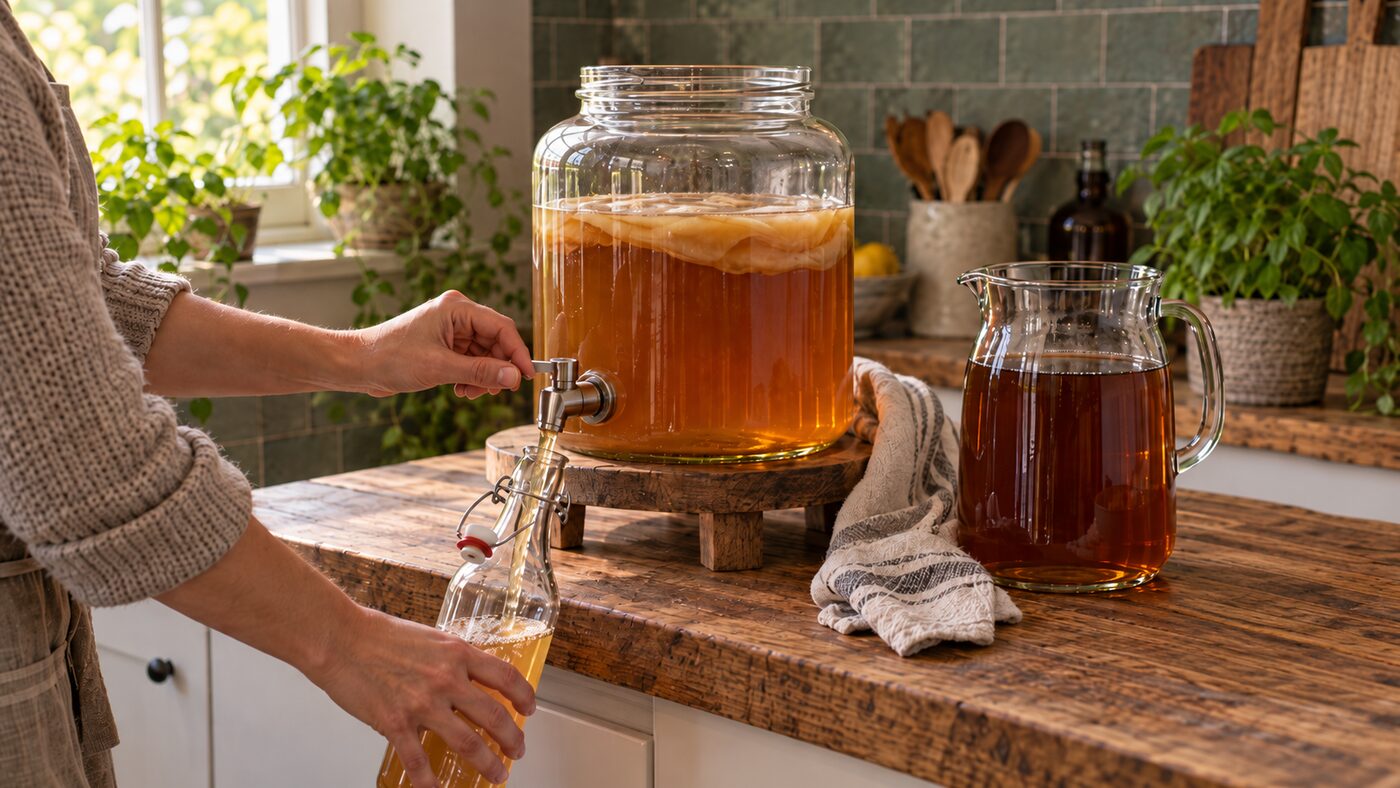
Continuous brew uses one large vessel with a spigot, from which you draw 20 to 30 percent of the kombucha every few days and replace it with the same amount of cooled sweet tea. The large volume of mature kombucha left behind acts as starter, so each top-up ferments fast and safely, and the culture is never handled.
It suits people who drink kombucha daily and want less work. It is less flexible for changing teas, harder to clean, and needs a spigot that is food safe.
How it works
In a batch, you start with 10 to 20 percent starter and wait a week or two for the whole jar to ferment. In a continuous brew you keep 70 to 80 percent of a finished, sour kombucha in the vessel at all times, so the fresh tea you add is outnumbered from the start. That acidifies it within hours instead of days, which is why continuous brews are both quicker and less prone to mold. The pellicle sits undisturbed at the top and keeps growing; the spigot lets you draw from below it without lifting anything out. It also explains why a continuous brew should never be started with only a splash of starter: the reservoir of acidity is the whole point.
This also makes continuous brew the lower-handling option day to day. The culture is almost never touched, exposed to open air only for the seconds it takes to draw and refill, and a well-established reservoir is a harder environment for stray mold spores to get a foothold in than a jar that starts fresh each time.
Setting up
- Choose a vessel of 4 to 10 liters with a spigot: glass, food-grade stainless steel, or ceramic you know is lead-free. The spigot must be 304-grade stainless steel or plastic on the inside, never brass, since cheaper plated fittings corrode under the acid; it should also sit a few centimetres above the base so it draws clear kombucha, not yeast sediment.
- Fill it like a normal batch: sweet tea at 5 g of tea and 60 to 70 g of sugar per liter, plus 20 percent strong starter and a SCOBY. How to make kombucha has the ratio.
- Let that first fill ferment fully, 10 to 14 days, until it is properly tart. Do not draw anything yet; you are building the reservoir of acidity that makes the method work.
- Draw a glass from the spigot to check it flows clear and tastes right. From here on, you are in the routine.
Put the vessel where it will live: a steady 20 to 26 °C, out of direct sun, with room to hold a bottle under the spigot. A full ten-liter vessel is heavy and you will not want to move it.
The routine
Draw off 20 to 30 percent of the volume, one to one and a half liters from a five-liter vessel, and bottle it as you would a batch, with fruit for a second fermentation or straight to the fridge. Then top up with the same volume of cooled sweet tea at the usual ratio. Taste before each draw: if it is sweeter than you like, wait a day or two; if it is sharper, draw more often. Most kitchens settle into a rhythm of a liter every two to four days, or a bigger draw once a week. Kombucha from the spigot is finished kombucha: drink it straight, chilled, or bottle it with fruit; the only difference from a batch is that there is always more behind it.
- Never take more than a third at once. The reservoir is the safety mechanism.
- Always cool the tea to room temperature before it goes in. Hot tea through a spigot vessel is the fastest way to kill a continuous brew.
- Keep the cloth cover on between draws, and rinse the spigot after each use; yeast loves to grow inside it.
The numbers
| Vessel | Draw at a time | Sweet tea to top up | Tea and sugar for it |
|---|---|---|---|
| 4 liters | 1 liter | 1 liter | 5 g tea, 60–70 g sugar |
| 6 liters | 1.5–2 liters | 1.5–2 liters | 8–10 g tea, 90–140 g sugar |
| 10 liters | 2–3 liters | 2–3 liters | 10–15 g tea, 120–210 g sugar |
Make the top-up tea the same way as for a batch, concentrated in part of the water and cooled with the rest, and pour it in gently down the side so the pellicle stays put. No new starter is needed; the vessel is the starter.
When it goes wrong
- Always sweet: you are drawing too often, too much, or the room is cold. Wait longer between draws, and never take more than a third.
- Always vinegar: you are not drawing enough. Take more, more often, and top up with the same amount.
- Cloudy, yeasty kombucha from the spigot: the sediment has built up to spigot height. Time for a clean-out, and draw a little more often afterwards.
- Weak fizz in the bottles: the drawn kombucha may contain too little active yeast or fermentable sugar. Avoid fine filtering, and try a small measured amount of sugar or fruit at bottling; check pressure early.
- The pellicle has grown enormous: normal after a couple of months. Thin it at the next clean-out; it does not need to be thick to work.
Pros and cons
- Faster and safer per liter, because every top-up starts in mature kombucha.
- Less handling: the SCOBY is never lifted, moved or rinsed, and there is no bowl of starter to keep track of.
- Kombucha whenever you want it, in the amount you want, without waiting for a whole batch.
- Easier on the culture in winter, because the large volume holds its temperature.
- Harder to change tea or experiment, since the vessel is always full of the old recipe.
- More cleaning when it is due: draining a full vessel, dealing with a thick pellicle stack, unclogging the spigot.
- Less precise. A batch has a start and an end you can log; a continuous brew is a moving average, and it takes tasting to know where it is.
- The spigot is one more thing that can leak or harbour yeast, and the vessel is bulky.
The honest summary: continuous brew makes more kombucha with less attention, at the cost of control. If you like tinkering with teas, temperatures and timings, keep a batch jar; if you just want the house kombucha on tap, this is the method.
Keeping it healthy for months
A continuous brew runs for months, but not forever without attention. Every two to three months, drain it down to a liter or two, scoop out the yeast sludge from the bottom, wash the spigot, and thin the pellicle stack to one or two layers; the rest go to a hotel or the compost. Refill with sweet tea and let it recover for a week before drawing. If the brew keeps coming out sweet, you are drawing too much or too often, or the room is cold; if it is always vinegar, draw more. Between clean-outs, a short monthly check keeps it honest: taste from the spigot, look at the surface, run hot water through the tap, and rinse the cloth. A pellicle that stops thickening, or a brew that stays sweet for a week despite the reservoir, means the culture is tired: add a cup of hotel starter and a fresh layer. Mold is rare in a continuous brew but not impossible, and the rule is the same as for any jar: dry, fuzzy spots mean everything goes, spigot included. Kombucha mold shows what to look for.
Frequently asked questions
Can I switch teas in a continuous brew?
Gradually. Top up with the new tea for several rounds and the vessel drifts toward it over a few weeks. A sudden switch, especially to green or white tea, can slow the culture for a round or two.
How much can I draw at once?
Usually no more than about a third of the vessel at once. A larger draw leaves less acidic kombucha to start the next cycle and can slow acidification; check the brew before drawing again.
Can I leave it while I am away?
Yes, for two or three weeks. Cover it and leave it; it will be very sour when you return. Draw off most of it for starter and hotel liquid, top up, and it recovers in a few days.
My spigot drips or clogs. What now?
Drips usually mean the gasket has shifted or perished; take it apart, clean it, and reseat or replace it. Clogs are yeast; run hot water through it and draw a little more often so it does not sit still.
Is continuous brew better than batches?
Better for daily drinkers who want convenience and consistency. Batches are better for learning, for experimenting with teas and flavors, and for anyone who brews occasionally. Many people do both: a continuous vessel for the house kombucha and a jar for trials.
Is a continuous brew actually safer than batches?
A little, yes. Because most of the vessel is already acidic kombucha, a fresh top-up drops in pH within hours rather than days, and the culture is rarely exposed to open air or handled with hands or utensils. Neither method is unsafe when starter and cleanliness are right, but continuous brew leaves less room for the mistakes, like too little starter, that cause most kombucha problems.
Sources
The guidance above draws on these references. Health and safety points are conservative on purpose: home brewing has real variability, and no article can check your batch for you.
These guides were drafted with AI assistance and reviewed by a hobby home kombucha brewer.
- Cultures for Health: Kombucha brewing vessels and continuous brewing containers
- Colorado State University Extension: Understanding and Making Kombucha
- BC Centre for Disease Control: Safety of Fermented Foods, section 3.11 Kombucha and Jun (2024)
- Kombucha Kamp: Kombucha mold information and pictures
- Nummer, B. A. (2013). Kombucha brewing under the FDA model Food Code: risk analysis and processing guidance. Journal of Environmental Health