In short
Plain black tea, or a blend of black and green, is the reliable choice: it feeds the culture well, ferments predictably, and tastes like the kombucha most people know. Green tea makes a lighter, faster, more delicate brew; white and oolong sit in between. Use about 5 g of tea (two bags) per liter, steep it 10 to 15 minutes, and avoid anything with added oils or flavourings, such as Earl Grey.
Herbal “teas” with no real tea leaves cannot sustain the culture on their own, and decaffeinated tea works but slowly. Whatever tea you choose, keep the sugar plain and white.
Why the tea matters to the culture
The bacteria and yeasts in a kombucha culture get their energy from sugar, but they get almost everything else from the tea: nitrogen, minerals, and a set of polyphenols and caffeine that the community has adapted to over generations. Real tea, Camellia sinensis, supplies all of it. Studies that ferment the same culture on different teas find that the tea changes the acidity, the sugar and alcohol left at the end, the polyphenol content, and even which microbes dominate. It is a substrate, not a flavouring.
That is why the classic advice is “plain tea, real tea”: black or green, without oils, without dried fruit, without added aromas. Everything else in this guide is a refinement of that.
Black, green, white, oolong, and the rest
| Tea | In the jar | In the glass | Good for |
|---|---|---|---|
| Black | Reliable, steady fermentation; robust culture; darker pellicle. Studies find it produces the most acid. | Full, rounded, cider-like. The classic kombucha taste. | Beginners, a strong culture, fruit flavors at bottling |
| Green | Ferments a little faster; lighter pellicle; highest measured polyphenols after fermentation. | Lighter, grassy, crisp, with a gentler sourness. | Summer batches, delicate flavors, people who find black too heavy |
| White | Slower and subtler; the culture may take a batch to adapt. | Soft, delicate, slightly sweet even when tart. | Light second fermentations with herbs or flowers |
| Oolong | Between black and green; good acid production. | Floral, complex, sometimes nutty. | Drinking plain, without added flavor |
| Pu-erh and dark teas | Ferment well; strong, dark, earthy brews. | Deep, earthy, a little wine-like. | Experienced brewers who like a bold cup |
| Yellow | Similar to green, rarer and pricier. | Mellow, between green and white. | Variety |
A useful way to think about it: black tea is the tea the culture is most used to, green is the tea most brewers move to once they know their culture, and the others are for taste. None of them is wrong. If a culture has been living on black tea for a year and you switch it to white, expect a slower first batch and give it a little extra starter.
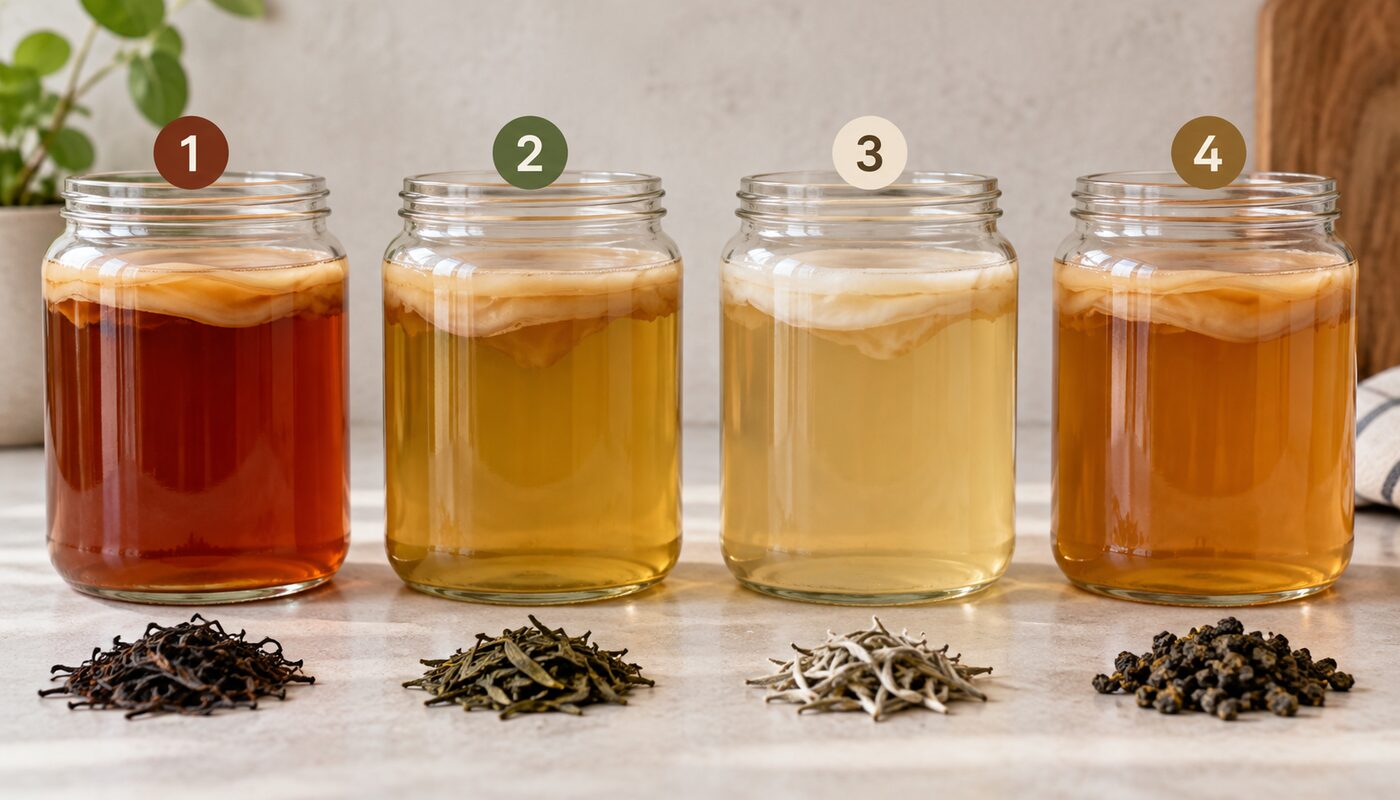
- BlackFull, rounded, cider-like. The classic kombucha taste.
- GreenLighter, grassy, crisp, with a gentler sourness.
- WhiteSoft, delicate, slightly sweet even when tart.
- OolongFloral, complex, sometimes nutty.
Blending teas
Most experienced brewers settle on a blend, and 70 percent black with 30 percent green is the most common. The black keeps the culture strong and the flavor familiar; the green lightens the drink and softens the sourness. Fifty-fifty works too. Blends also let you use up odds and ends of loose tea, as long as each one is plain. Keep the total amount of tea the same; you are changing the mix, not the strength.
Switching teas without upsetting the culture
A culture adapts to the tea it lives on. Switch abruptly from black to white and the first batch may run slow and the pellicle come out thin; that is adaptation, not failure. Ease the change and the culture follows.
- Change gradually: replace a quarter of the tea per batch until you reach the new blend.
- Use the higher end of the starter range, 20 percent, for the first batch on a new tea.
- Keep the hotel on black tea. A black-tea hotel gives you strong, familiar starter to reset from, whatever you experiment with in the jar.
- Watch taste, not the disc. A thin pellicle on a new tea with a properly tart batch underneath is a healthy culture doing its job.
Two signs that a tea is not working for your culture: batches that stay sweet for weeks despite warmth and starter, and a pellicle that stops forming altogether over two or three rounds. Both usually mean the tea is short of what the culture needs, most often because it was flavoured, herbal, or decaffeinated. Go back to plain black tea for a batch or two and the culture recovers.
Teas to avoid, or to use with care
- Flavoured teas with oils: Earl Grey (bergamot oil), jasmine scented with oils, chai blends, and anything “with natural flavours”. The oils coat the culture and weaken it over successive batches. Save them for the second fermentation, where the culture is not involved.
- Herbal infusions without tea leaves, such as rooibos, hibiscus and mint, can ferment, but the result and culture performance may differ from a tea-based batch. Keep a separate culture for experiments or use the herbs at bottling.
- Smoked teas such as lapsang souchong. Not harmful, but the smoke dominates and the sourness makes it strange.
- Heavily flavoured or sweetened instant teas and bottled teas. Unknown additives, often preservatives, and no guarantee of real tea.
- Decaffeinated tea: it works, because the culture needs the tea more than the caffeine, but batches run slower and the culture can weaken over time. Alternate with regular tea.
How much tea, and how to brew it
- Amount: about 5 g of loose tea per liter, which is two standard tea bags. Up to 8 g gives a stronger, more tannic brew. Less than 3 g starves the culture.
- Steeping: 10 to 15 minutes in water just off the boil for black tea, and slightly cooler water for green if you want to avoid bitterness. Longer than a cup of tea, on purpose: the starter dilutes it and fermentation mellows it.
- Water: filtered or boiled tap water. Chlorine evaporates when you boil; chloramine does not, so if your water is treated with it, a carbon filter helps. Very soft water can make a sluggish brew; very hard water tastes chalky.
- Bags or loose: both are fine. Loose tea is cheaper per batch and usually better quality; bags are convenient. Remove either after steeping, and never leave leaves in the fermenting jar.
- Concentrate trick: brew the tea strong in a third of the water, then top up with cold water to cool it fast. Same tea, same result, less waiting.
- Organic or not: it makes no difference to the ferment. Freshness and quality matter more than certification; whole-leaf tea gives a cleaner flavor than dusty, stale bags.
And the sugar: keep it simple
Sugar is the other half of the substrate, and here the advice is even simpler. Plain white sugar, cane or beet, is the most reliable food for the culture and gives the cleanest result. Raw or golden cane sugar works and adds a faint molasses note. Brown sugar and muscovado ferment but taste heavy and can make the culture sluggish. Honey belongs to jun, a related drink with its own culture. Maple syrup, coconut sugar, and agave are inconsistent. Artificial and zero-calorie sweeteners do not ferment at all: no sugar, no kombucha.
Use 60 to 70 g per liter as a dependable starting point. You can adjust the sugar gradually, but check that each changed batch acidifies normally. A longer ferment can taste less sweet, although the remaining sugar varies. How to make kombucha has the full ratio, and how long to ferment kombucha explains what the extra days do.
Frequently asked questions
Can I use tea bags for kombucha?
Yes. Two standard bags per liter is the usual amount. Check that the bag is plain tea with no added flavours, and remove the bags after steeping. Loose tea is often better value and quality, but bags make perfectly good kombucha.
Can I make kombucha with green tea only?
Yes. Green tea kombucha is lighter, ferments a little faster, and is very popular. Watch the first batch after switching from black, and use plenty of starter; the culture adapts within a batch or two.
Does kombucha still have caffeine if I use green tea?
Yes. The amount varies with the tea and the brew; fermentation does not reliably remove caffeine. Green tea is not always lower in caffeine than black tea, so use decaffeinated tea if you need to limit it.
Can I use coffee, yerba mate, or rooibos instead of tea?
Rooibos and some other sweetened infusions can ferment, but results vary by culture and recipe. Use a separate culture if you want to experiment, and make sure the batch acidifies normally. Coffee and yerba mate also change the flavor and fermentation.
Will the tea change the colour of my SCOBY?
Yes. Black tea gives a tan to brown pellicle; green and white give a paler, creamier one. Neither is healthier; it is just the tea staining the cellulose.
Can I reuse tea leaves for a second batch of sweet tea?
Not for kombucha. A second steep is much weaker in the compounds the culture needs. Use fresh tea for every batch and compost the leaves.
Does organic tea make better kombucha?
Not measurably, as far as the ferment goes. What does change the result is freshness and quality: whole-leaf, unflavoured tea bought recently gives a cleaner batch than a box of bags forgotten at the back of the cupboard. Choose organic if it matters to you for other reasons, not for the culture.
Sources
The guidance above draws on these references. Health and safety points are conservative on purpose: home brewing has real variability, and no article can check your batch for you.
These guides were drafted with AI assistance and reviewed by a hobby home kombucha brewer.
- Gaggìa, F. et al. (2019). Kombucha beverage from green, black and rooibos teas: a comparative study looking at microbiology, chemistry and antioxidant activity. Nutrients
- Jakubczyk, K. et al. (2020). Chemical profile and antioxidant activity of the kombucha beverage derived from white, green, black and red tea. Antioxidants
- Comprehensive evaluation of quality and bioactivity of kombucha from six major tea types in China (2024). International Journal of Gastronomy and Food Science
- Colorado State University Extension: Understanding and Making Kombucha
- Jayabalan, R. et al. (2014). A review on kombucha tea: microbiology, composition, fermentation, beneficial effects, toxicity, and tea fungus. Comprehensive Reviews in Food Science and Food Safety